
Please note: This website contains affiliate links. As an Amazon Associate, we earn from qualifying purchases at no additional cost to you.
Let’s be honest: walking down the snack aisle these days feels like a high-stakes botanical exam.
With over 50 varieties of nuts and seeds scattered across the globe, it’s easy to get overwhelmed. Do you choose the one that looks like a tiny brain, or the one that requires a literal industrial vice to crack open? Most people just grab whatever is covered in honey and salt and hope for the best.
But if you’re training like an athlete or trying to drop a pant size, “hoping for the best” isn’t a strategy. While most nuts are perfectly fine in their natural state, there is a massive difference between a nutritional powerhouse and a glorified calorie bomb masquerading as health food.
Think of this as your VIP guest list for the nut world. We’ve sifted through the fluff to find the absolute MVPs (Most Valuable Pistachios… and Walnuts, and Almonds). These are the overachievers—the healthy nuts that don’t just sit there looking pretty but actually put in the work to crush your cravings, fuel your recovery, and keep your metabolism firing.
So, put down the “maple-glazed-mystery-mix” and let’s dive into the science of the only nine nuts that truly deserve a permanent spot in your pantry.
1. Walnuts: The Brain & Longevity Nut
- Primary Benefit: Brain health & Inflammation
- Key Nutrient: Omega-3 Fatty Acids (ALA)
- The Stats (per 28g): 185 Calories | 4g Protein | 2g Fiber
- Best for: Athletes looking to reduce muscle inflammation and General Wellness seekers looking to support cognitive function.
The Science: Walnuts are unique for their high concentration of alpha-linolenic acid (ALA), a plant-based omega-3. Unlike other nuts, they contain significant amounts of polyphenols called pedunculagin, which are metabolized by gut bacteria into urolithins. These compounds have been shown to cross the blood-brain barrier and protect against neuroinflammation, making them vital for recovery from intense physical training.
2. Almonds: The Metabolism Regulator
- Primary Benefit: Gut health & Vitamin E
- Key Nutrient: Fiber & Antioxidants
- The Stats (per 28g): 160 Calories | 6g Protein | 3.5g Fiber
- Best for: Fat Loss, as they are highly satiating and help stabilize blood sugar levels.
The Science: Almonds are one of the best sources of alpha-tocopherol, the most absorbable form of Vitamin E. They possess a “bioavailability advantage”: because of their rigid cellular structure, a portion of the fat remains trapped in the fiber during digestion. Research suggests we may absorb significantly fewer calories from almonds than listed on the label, making them an elite choice for weight management.
3. Brazil Nuts: The Thyroid Commander
- Primary Benefit: Thyroid support
- Key Nutrient: Selenium
- The Stats (per 28g): 187 Calories | 4g Protein | 2g Fiber
- Best for: General Wellness and anyone struggling with a “sluggish” metabolism.
The Science: These are the richest known food source of selenium, a trace mineral required for the synthesis of selenoproteins. These proteins are essential for converting inactive T4 thyroid hormone into the active T3 form, which regulates your basal metabolic rate. Just one to two nuts a day provides your full daily requirement to support the immune system and thyroid health.
4. Pistachios: The “Skinny” Nut
- Primary Benefit: Eye health & Weight management
- Key Nutrient: Lutein & Zeaxanthin
- The Stats (per 28g): 159 Calories | 6g Protein | 3g Fiber
- Best for: Weight Loss (low calorie-per-unit) and Athletes (complete protein for muscle repair).
The Science: Pistachios are a “complete protein,” containing all nine essential amino acids required for muscle repair. They are also rich in the carotenoids lutein and zeaxanthin, which are typically found in leafy greens. These antioxidants are vital for eye health and protecting the skin against UV damage, offering a unique benefit for outdoor athletes.
5. Cashews: The Bone & Mineral Nut
- Primary Benefit: Bone health & Iron
- Key Nutrient: Magnesium & Copper
- The Stats (per 28g): 157 Calories | 5g Protein | 1g Fiber
- Best for: Athletes who need minerals for bone health and those prone to anemia.
The Science: Lower in fat than most nuts, cashews are a powerhouse of magnesium and copper. Magnesium acts as the “gatekeeper” for calcium entering your bones, while copper is a critical cofactor for lysyl oxidase, an enzyme that cross-links collagen and elastin. This provides essential strength and flexibility to joints and connective tissues.
6. Pecans: The Heart Guardian
- Primary Benefit: Heart health
- Key Nutrient: Flavonoids & Gamma-tocopherols
- The Stats (per 28g): 196 Calories | 3g Protein | 3g Fiber
- Best for: Healthy Lifestyle followers focused on longevity and cardiovascular health.
The Science: Pecans boast the highest Oxygen Radical Absorbance Capacity (ORAC) of all common nuts. They are particularly rich in gamma-tocopherols, a form of Vitamin E that research suggests can prevent the oxidation of LDL cholesterol. By preventing this oxidation, pecans help inhibit the formation of arterial plaque, serving as a primary dietary tool for heart health.
7. Macadamias: The Healthy Fat & Skin Nut
- Primary Benefit: Metabolic health & Skin elasticity
- Key Nutrient: Monounsaturated Fats (Omega-7)
- The Stats (per 28g): 204 Calories | 2g Protein | 2g Fiber
- Best for: Fat Loss (specifically for low-carb/Keto diets) and those looking to improve skin health.
The Science: Macadamias are defined by their high concentration of palmitoleic acid (Omega-7). This rare monounsaturated fat acts as a “lipokine,” signaling the body to improve insulin sensitivity and suppress the enzymes that cause the body to store fat. It is also a key component of human sebum, helping maintain skin moisture from the inside out.
8. Hazelnuts: The Nerve & DNA Support Nut
- Primary Benefit: Skin & Heart health
- Key Nutrient: Folate & Manganese
- The Stats (per 28g): 176 Calories | 4g Protein | 3g Fiber
- Best for: General Wellness and recovery-focused individuals.
The Science: Hazelnuts are an exceptional source of manganese, a trace mineral that forms part of the antioxidant enzyme superoxide dismutase (SOD). SOD is the body’s first line of defense against free radical damage within the mitochondria. Their high proanthocyanidin content also helps support healthy blood flow and can reduce the severity of exercise-induced inflammation.
9. Pine Nuts: The Appetite Crusher
- Primary Benefit: Appetite suppression
- Key Nutrient: Pinolenic Acid
- The Stats (per 28g): 191 Calories | 4g Protein | 1g Fiber
- Best for: Weight Loss and controlling overeating during the day.
The Science: Pine nuts contain pinolenic acid, a unique polyunsaturated fat. Clinical studies show that pinolenic acid stimulates the release of cholecystokinin (CCK) and GLP-1, hormones that signal the brain to feel full and slow down gastric emptying. This natural appetite-suppressing effect makes them a strategic tool for managing caloric intake.
What to Skip: The Processed Trap
While the “Big 9” are nutritional heroes, they can become health hazards if they are:
- Oil-Roasted: Often cooked in inflammatory seed oils like soybean or cottonseed oil.
- Sugar-Coated: “Honey roasted” varieties add unnecessary glycemic load.
- High-Sodium: Excessive salt can counteract the natural heart benefits of the nuts.
Pro-Tip: Always buy “Raw” or “Dry Roasted” to ensure you are getting the nutrients without the additives.
Which Nut is Best for YOU?
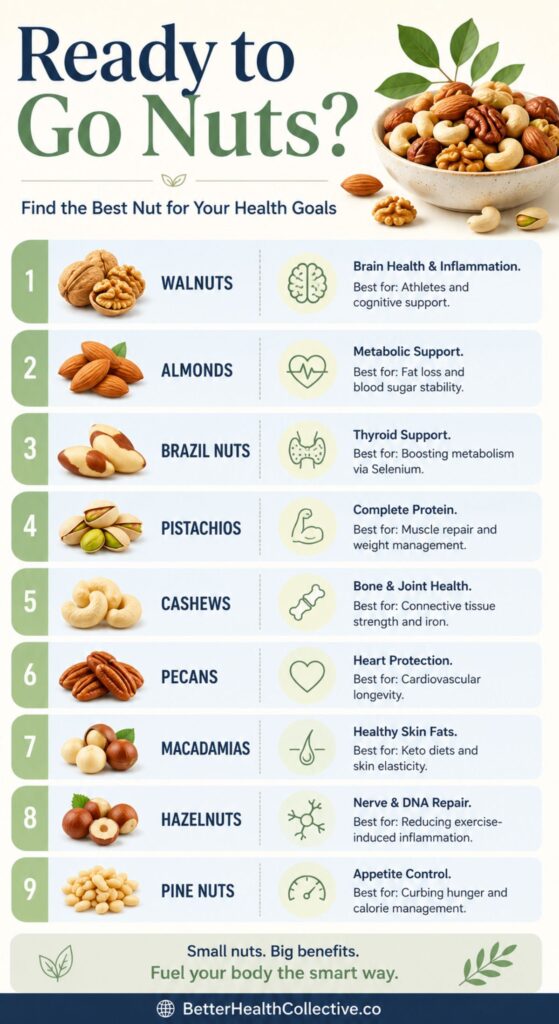
Here’s a quick comparison of the health benefits….
| Nut Variety | Benefit & Best For |
|---|---|
| Walnuts |
Brain Health & Inflammation. Best for: Athletes and cognitive support. |
| Almonds |
Metabolic Support. Best for: Fat loss and blood sugar stability. |
| Brazil Nuts |
Thyroid Support. Best for: Boosting metabolism via Selenium. |
| Pistachios |
Complete Protein. Best for: Muscle repair and weight management. |
| Cashews |
Bone & Joint Health. Best for: Connective tissue strength and iron. |
| Pecans |
Heart Protection. Best for: Cardiovascular longevity. |
| Macadamias |
Healthy Skin Fats. Best for: Keto diets and skin elasticity. |
| Hazelnuts |
Nerve & DNA Repair. Best for: Reducing exercise-induced inflammation. |
| Pine Nuts |
Appetite Control. Best for: Curbing hunger and calorie management. |
All About Healthy Nuts: Frequently Asked Questions (FAQ)
1. How many nuts should I eat per day?
A standard serving size is roughly 1 ounce (28 grams), which fits into the palm of a small hand. For most people, 1–2 servings per day provide the maximum nutritional benefit without excessive caloric intake.
2. Are raw nuts better than roasted nuts?
Raw nuts preserve the most delicate fats (like Omega-3s) and enzymes. However, if you prefer the taste of roasted nuts, look for “Dry Roasted” options. Avoid nuts roasted in vegetable oils (like canola or soybean oil), as these can increase inflammation.
3. Why aren’t peanuts on this list?
Peanuts are technically legumes, not tree nuts. While they do offer protein, they are often higher in omega-6 fatty acids and susceptible to aflatoxins (a type of mold). While not “bad” in moderation, they don’t offer the same elite nutrient density as the nine listed above.
4. Can eating nuts really help with weight loss?
Yes! Despite being high in calories, nuts are rich in fiber and protein, which trigger satiety hormones. Studies on almonds and pistachios also show that our bodies don’t absorb 100% of the fat found in their rigid cell walls, making them more “diet-friendly” than processed snacks.
5. Should I soak my nuts before eating them?
Soaking nuts (sometimes called “activating”) can help reduce phytic acid, an anti-nutrient that can interfere with mineral absorption. While not strictly necessary for everyone, it can be very helpful for those with sensitive digestion or those relying on nuts for the majority of their mineral intake.
6. How should I store my nuts to keep them fresh?
Because of their high healthy-fat content, nuts can go rancid quickly when exposed to heat, light, and air. To maximize shelf life and preserve those fragile antioxidants, store your nuts in an airtight container in the refrigerator or freezer.
Please note: This website contains affiliate links. As an Amazon Associate, we earn from qualifying purchases at no additional cost to you.