



Please note: This website contains affiliate links. As an Amazon Associate, we earn from qualifying purchases at no additional cost to you.
It’s 8:45 PM. You just finished a perfectly good, filling dinner.
You should be satisfied. Instead, you find yourself standing in front of the pantry like a detective at a crime scene, hunting for a stray bag of chocolate chips or that one “emergency” sleeve of cookies.
If that sounds familiar, welcome to the club.
For years, I assumed my nightly kitchen raids were just a personality trait. I figured I was born with a “sweet tooth” and zero willpower. But after I stopped blaming my character and started looking at my habits, I realized something: These cravings aren’t random. They’re a cycle.
The good news? You don’t need a “perfect” diet or a willpower transplant to fix it. You just need to stop the rollercoaster.
The Blood Sugar Rollercoaster
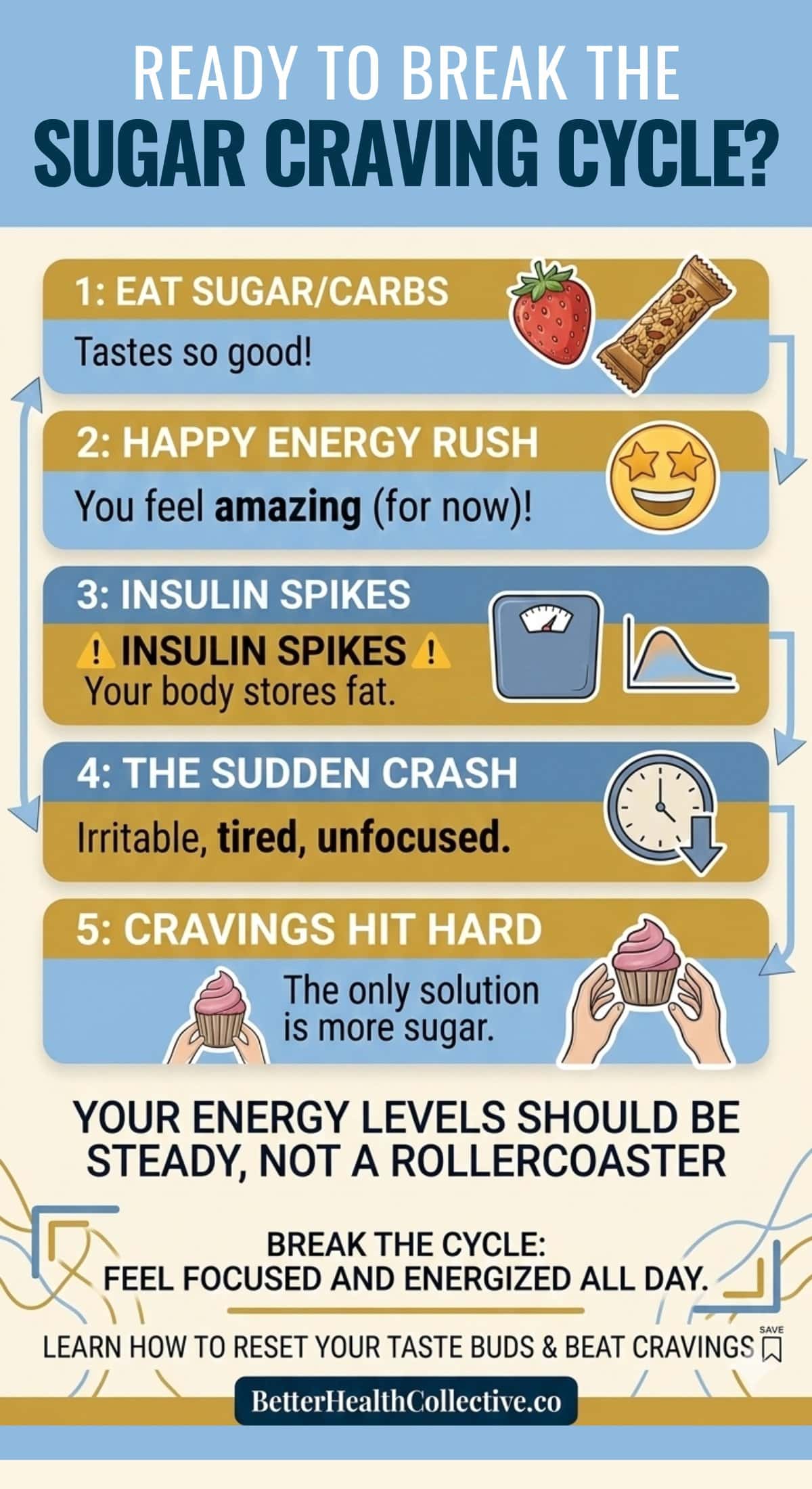
Most sugar cravings follow a predictable, annoying pattern. It’s not a lack of discipline; it’s biology. It looks like this:
Sugar/Refined Carbs → The High → The Crash → The Panic → Repeat.
Here’s the play-by-play:
You eat something high in sugar or “white” carbs (think: that afternoon muffin, a sweetened latte, or white pasta). Your body turns that into fuel instantly. For twenty minutes, you’re a superhero.
Then comes the floor-drop. Your energy craters. You feel “hangry,” foggy, and suddenly desperate for another quick hit of energy. Your brain knows that sugar is the fastest way to get that high back, so it starts screaming for a donut.
And just like that, you’re back at the start of the loop.
Is Your Body Stuck on Autopilot?
Most of us are stuck in this cycle without even realizing it. You might be in the loop if:
- You feel like a zombie if you don’t have dessert after lunch.
- The “3 PM Slump” is the hardest part of your day.
- You’re hungry again exactly 45 minutes after eating a big meal.
- “Brain fog” is your default setting.
- You get shaky or irritable if your lunch is even ten minutes late.
This isn’t about being “weak.” It’s just your body being trained to rely on cheap, fast fuel. The cool part? You can retrain it surprisingly fast.
Why Sugar is a Master Manipulator
The more sugar you eat, the more your taste buds go numb to it.
When you’re eating “hidden” sugars all day, a piece of fruit tastes like cardboard. But when you actually break the cycle for a week or two, something magical happens: Your taste buds reset. Suddenly, a strawberry tastes like a candy bar. That “favorite” dessert you used to crave? It starts to taste cloyingly sweet—almost gross. That’s the moment you know you’ve won.
The “Healthy” Foods Keeping You Hooked
One reason people struggle to break the cycle is that sugar is a master of disguise. It’s hiding in things that sound healthy. I’m talking about:
- The “low-fat” yogurt that’s actually a dessert in disguise.
- Granola bars that have more sugar than a Snickers.
- Pasta sauce that’s basically tomato-flavored syrup.
- That $9 “green juice” that’s mostly apple juice.
When these “healthy” foods trigger that spike-and-crash all morning, you’re doomed to crave a brownie by 4:00 PM.
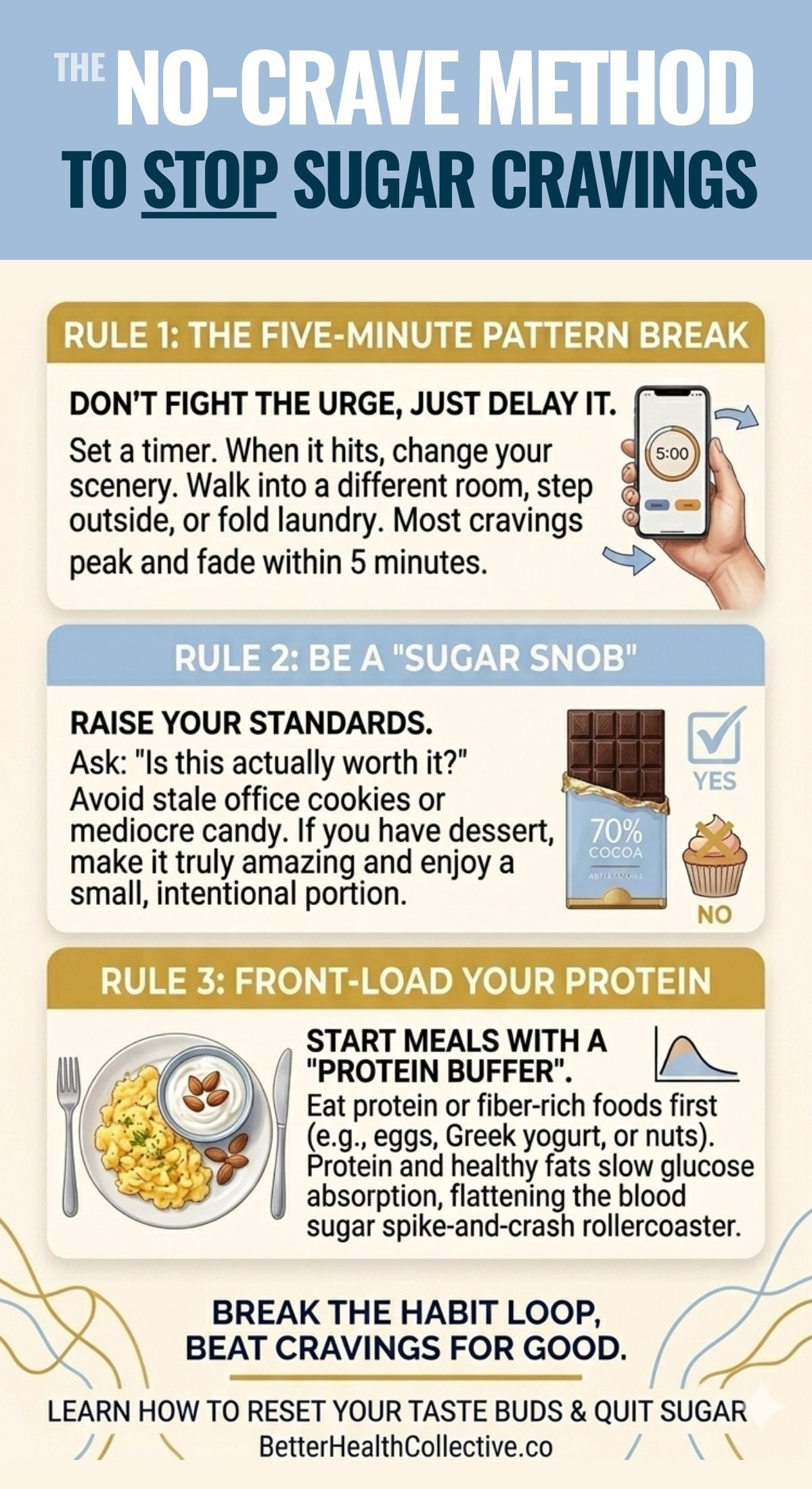
The “No-Crave Method”: 3 Rules to Silence the Food Noise
Understanding the biological rollercoaster is the first step, but knowing how to handle a craving when it’s screaming at you in real-time is where the magic happens.
The No-Crave Method isn’t about white-knuckling your way through cravings. It’s a set of three tactical “pattern interrupters” designed to short-circuit the habit loops in your brain, making the cravings fade naturally rather than fighting them head-on.
Rule 1: The Five-Minute “Pattern Break”
When a craving hits, your brain isn’t necessarily hungry—it’s looking for a reward it associates with a specific environment. Maybe it’s the couch after dinner or the office breakroom at 3 PM.
Don’t fight the urge; just delay it. Set a timer for five minutes and physically move your body.
- Change your scenery: Step outside, walk into a different room, or do a quick chore.
- Hydrate: Drink a large glass of water; dehydration often masquerades as a sugar craving.
- A quick sensory reset: Sniff some peppermint oil or brush your teeth. The minty flavor sends a “kitchen is closed” signal to your brain.
Rule 2: Raise Your “Dessert Standards”
One of the fastest ways to trigger a massive craving is to tell yourself you can never have sweets again. Restriction creates obsession. Instead, become a “Sugar Snob.”
Before you eat something sweet, ask: “Is this actually worth it?”
- The “No” List: Stale breakroom cookies, mediocre grocery store cupcakes, or candy you’re eating just because it’s there.
- The “Yes” List: A high-quality dessert at a special celebration or a small piece of truly artisanal dark chocolate (70% cocoa or higher) that you genuinely love.
By raising your standards, you remove the “mindless” sugar that fuels the rollercoaster while still allowing for intentional enjoyment.
Rule 3: Start Meals with “Protein First”
The order in which you eat your food is a secret weapon for blood sugar stability. When you lead with carbohydrates (like a piece of toast or a bowl of cereal), you’re inviting a spike.
Always lead with a “Protein Buffer.” Before you touch the carbs, eat a few bites of:
- Eggs or Greek yogurt
- Nuts, seeds, or a piece of cheese
- Fiber-rich veggies (like a small side salad or some broccoli)
Protein and healthy fats act like a “brake” for your digestion. They slow down the absorption of glucose into your bloodstream, flattening the curve of the spike-and-crash. This one small tweak can be the difference between a productive afternoon and a 3 PM desperate dash for a candy bar.
If you need some easy high protein meal ideas, we have it covered! Try some of these simple recipes…
- 21 High Protein Breakfast Ideas with 30g+ Protein
- High Protein Low Calorie Lunch Ideas Under 400 Calories
- High Fiber Breakfast Ideas to Reduce Sugar Cravings & Keep You Full
What Life Looks Like on the Other Side
Once you break the cycle, things change. You’ll notice:
- Your energy stays “level” all day (no more 3 PM naps).
- The “hangry” outbursts disappear.
- You actually feel full after a meal.
- The Best Part: You finally feel in control. You can have a piece of cake because you want it, not because your body is demanding it.
Ready to Reset?
Understanding the loop is half the battle. The other half is taking action. If you’re tired of the “crash and burn” lifestyle, I’ve put together a realistic, no-nonsense plan to help you get your energy back.
Check out the guide: How to Quit Sugar Without Going Crazy
The Quick Hits (Frequently Asked Questions)
Why do I turn into a sugar-monster at night?
It’s usually a mix of habit and fatigue. Your brain is tired, your willpower is spent, and you’ve “rewarded” yourself with sugar for so long that your brain has Pavlov’d itself into expecting it. Learn more about late night cravings – and how to nip them in the bud.
Is it normal to feel like I’m “withdrawing”?
Totally. If you’ve been on the rollercoaster for years, the first few days of hopping off can feel a bit sluggish. Stick with it—the “taste bud reset” is just around the corner.
If I do eat sugar, when is the best time to have it?
Many people find that having sugar with or after a balanced meal works better than eating it by itself. When sweets are paired with foods that contain protein, fiber, or healthy fats, the body tends to absorb sugar more slowly, which can help reduce the sharp energy spikes and crashes that often lead to cravings later.
So if you want to indulge in some dessert, go ahead! Just do it after dinner instead of just a standalone snack. This gives you the freedom to have that sweet treat and avoid the rollercoaster cycle of sugar cravings throughout the day.
Do I have to give up chocolate forever?
Absolutely not. The goal isn’t to never eat a cookie again; it’s to make sure the cookie isn’t the one calling the shots.
How much sugar is too much each day?
Health organizations generally recommend limiting added sugar to about 25 grams (6 teaspoons) per day for women and 36 grams (9 teaspoons) per day for men.
The challenge is that added sugar can show up in many packaged foods throughout the day — from yogurt and granola bars to salad dressings and sauces — so it can add up quickly. Simply becoming more aware of hidden sugars and choosing whole foods more often can dramatically reduce how much added sugar you consume.
Want some more tips on quitting sugar?
Hear from someone who dramatically decreased her daily sugar intake. She offers some fantastic tips, so this video is well worth 10 minutes of your life…
Final Thoughts
Sugar cravings can feel frustrating, especially when they seem to show up out of nowhere. But in many cases, they’re simply the result of patterns your body has learned over time — energy spikes, hidden sugars, daily habits, and emotional triggers that quietly reinforce the cycle.
The encouraging part is that once you understand what’s happening, small changes can make a big difference. Becoming more aware of where sugar is hiding, eating balanced meals, and breaking the automatic craving routine can help your body gradually reset.
And over time, many people discover something surprising: the foods they once craved every day no longer have the same pull. When that happens, sugar stops controlling your choices — and becomes something you can enjoy occasionally instead of something you constantly want.
Don’t miss our No Sugar Challenge Guide: How to Quit Sugar (Without Losing Your Mind)
Please note: This website contains affiliate links. As an Amazon Associate, we earn from qualifying purchases at no additional cost to you.