Please note: This website contains affiliate links. As an Amazon Associate, we earn from qualifying purchases at no additional cost to you.
It’s no secret that sugar is everywhere these days.
It’s easy to spot in a dessert or a soda, but it’s also hiding in places you might not expect—like your favorite salad dressing, yogurt, or even that “healthy” granola bar. Most of us aren’t trying to eat a mountain of sugar; it just quietly adds up throughout the day.
Health organizations suggest keeping added sugar under 25–36 grams a day. Yet, many of us are unknowingly eating double or triple that amount by lunchtime without even trying.
If you’ve ever felt like:
- Scouring the pantry for “something sweet” at 9:00 PM.
- Your energy completely tanks around 3:00 PM.
- Thinking about your next snack while you’re still eating lunch.
…it’s very likely you’re stuck in a sugar cycle.
I’ve struggled with this myself for years. I used to think my “sweet tooth” was just part of who I was. But here’s the wild part: once I stopped, my taste buds actually reset. Now, some of the stuff I used to love tastes like straight syrup.
The good news? You don’t have to go cold turkey tomorrow. We’re going to do this step-by-step so you don’t end up cranky and miserable.
Quick Reality Check
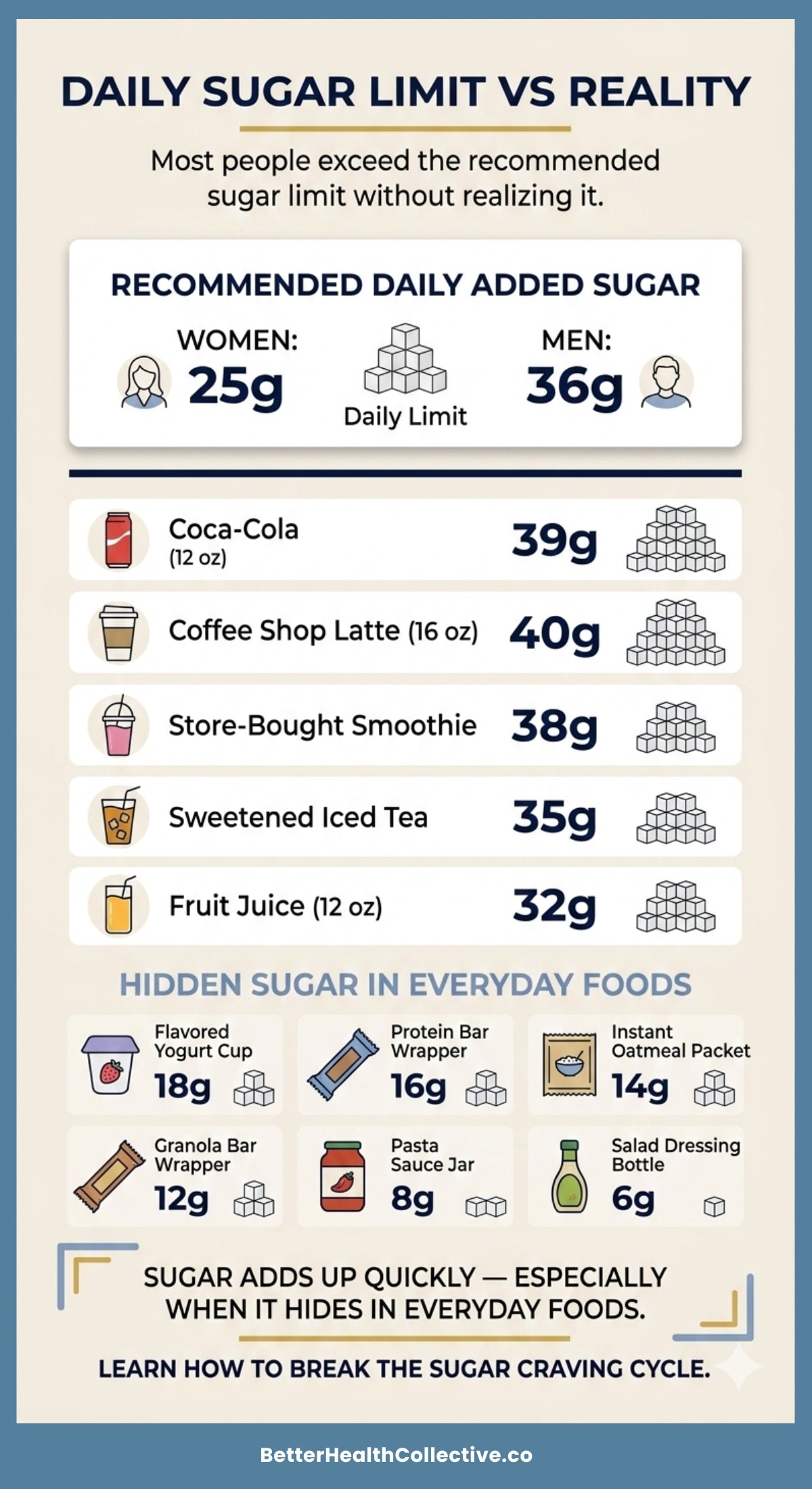
Before diving into the 30-day challenge, we thought it might helpful for you to see how quickly sugar often adds up throughout the day—especially when it hides in foods that don’t even taste very sweet.
Health experts generally recommend limiting added sugar to about:
- 25 grams per day for women
- 36 grams per day for men
Just one soda or sweet coffee drink can exceed that amount.
Common Foods That Contain More Sugar Than You Think
| Food or Drink | Typical Serving | Approx. Sugar |
|---|---|---|
| Coca-Cola | 12 oz can | 39 g |
| Sweetened iced tea | 16 oz bottle | 32–40 g |
| Store-bought smoothie | 15–16 oz bottle | 35–45 g |
| Flavored yogurt | 6 oz container | 15–20 g |
| Granola bar | 1 bar | 8–15 g |
| Protein bar | 1 bar | 10–20 g |
| Instant flavored oatmeal | 1 packet | 12–16 g |
| Bottled salad dressing | 2 tablespoons | 4–8 g |
| Ketchup | 1 tablespoon | 4 g |
| Pasta sauce | ½ cup | 6–10 g |
| Breakfast cereal | 1 cup | 12–18 g |
| Coffee shop flavored latte | 16 oz | 30–45 g |
| Fruit juice | 12 oz glass | 30–35 g |
| Sports drink | 20 oz bottle | 30–34 g |
| Sweetened almond milk | 1 cup | 7–13 g |
Quick note: I don’t know about you, but when I started really paying attention to the amount of sugar in some of the most basic foods I eat, I was genuinely horrified. Once you know the numbers, it becomes much easier to understand why sugar cravings can feel so hard to control.
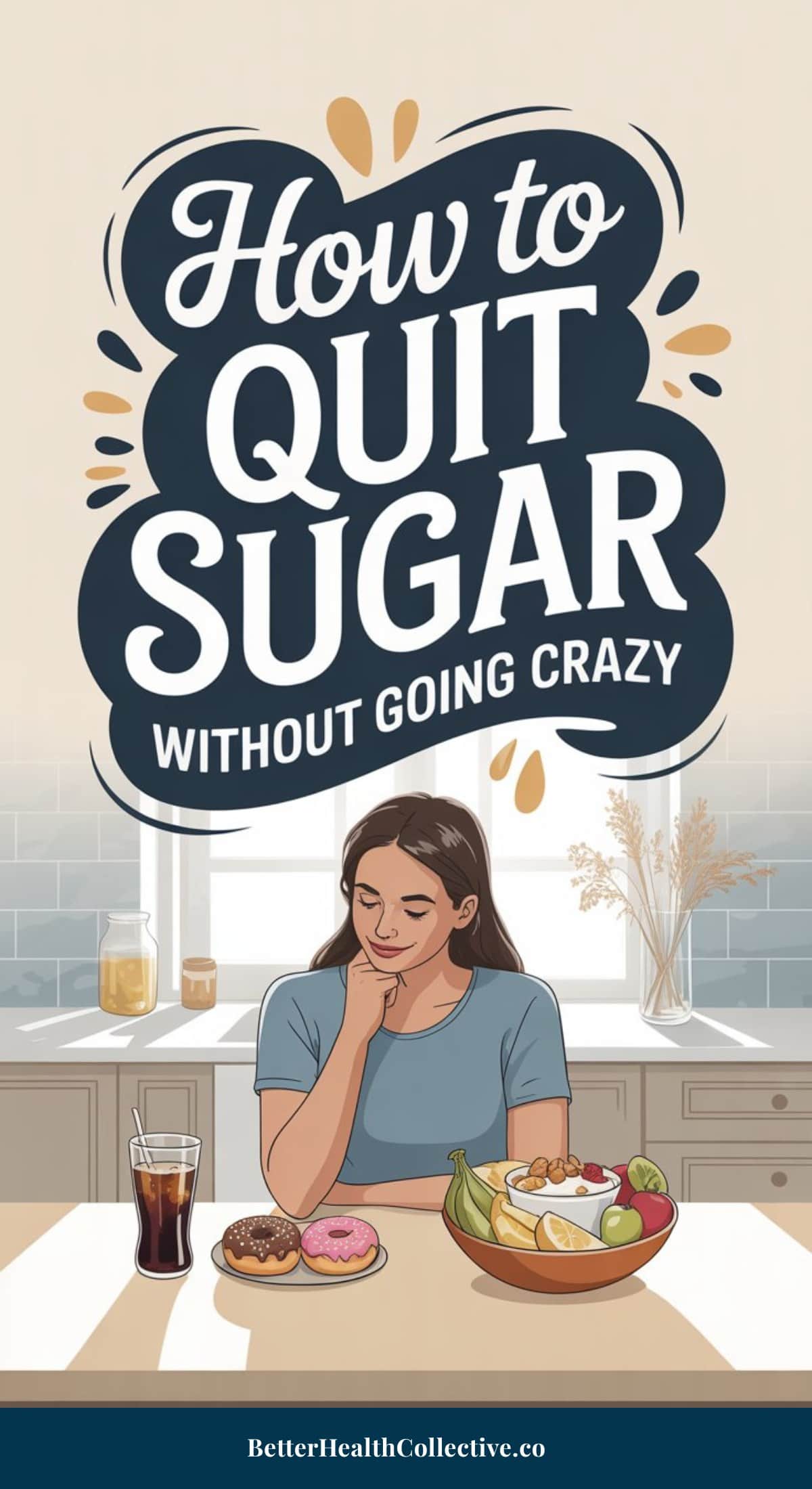
Save this pin as a reminder…
The 30-Day “Quit Sugar” Challenge
Ready to start this challenge?
Don’t worry. We aren’t aiming for perfection here. We’re just trying to convince your body to stop screaming for sugar every two hours.
Instead of trying to eliminate everything at once, we’ll start with the biggest sources of sugar first, then gradually clean up the smaller ones.
STEP 1 | Tackle the “Red Zone” Sugar Foods
For the first two weeks, don’t worry about the hidden stuff in bread or pasta sauce. Just look at the “Red Zone”—the high-impact hits like:
- Sodas, energy drinks, and those fancy 600-calorie coffee drinks
- The office candy jar
- Dessert as a daily requirement
Just cutting these out usually drops your sugar intake by at least 50% overnight.
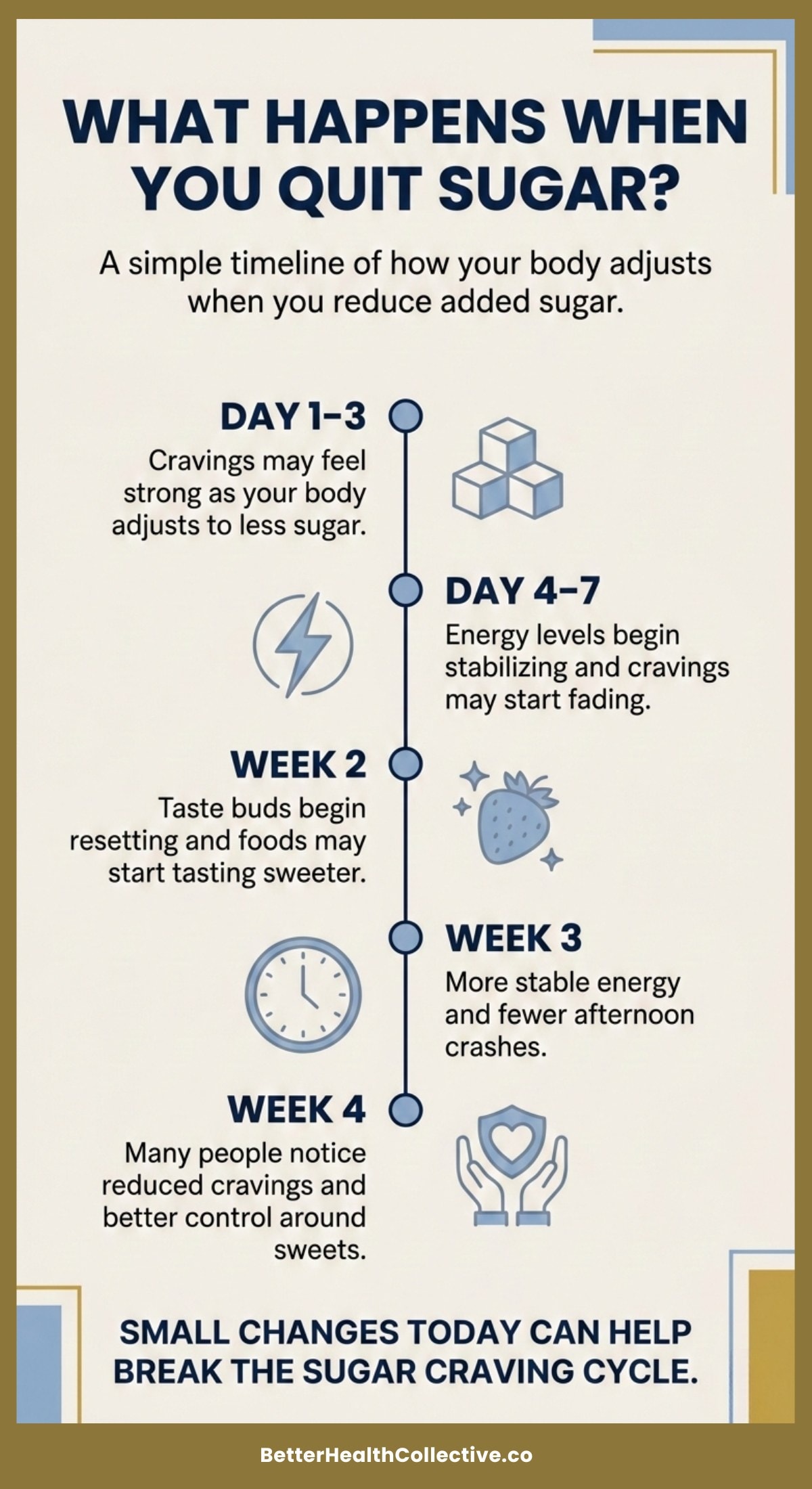
These foods tend to trigger the strongest cravings, so you should notice a difference towards the end of week one. For the first 1–2 weeks of the challenge, simply focus on cutting back or eliminating these red zone foods.
You don’t need to worry about fruit or carbohydrates yet. Just start with the obvious stuff.
STEP 2 | Don’t Eliminate Snacks — Replace Them
The biggest mistake people make is trying to “white knuckle” it through hunger. That never works. If you remove a sugary snack, you must replace it with something satisfying.
The Swap: Instead of a granola bar, grab some salted almonds. Instead of a cookie, try full-fat Greek yogurt with a few berries.
Here are a few more simple food swaps and simple recipes you can try:
- Fruit like apples or berries
- Dark chocolate in small amounts
- Cottage Cheese Blueberry Bake
- Berry Chia Cottage Cheese Bowl
- Herbal tea or lemon water
- Healthy Chocolate Shake (just skip the syrup for a no-added-sugar treat))
PRO TIP: Keep dark chocolate (70% or higher) in the house for emergencies. It hits the spot without the sugar spike.
Step 3 | Use the “5-Minute Rule” for Cravings
Sugar cravings are like waves—they peak, and then they crash.
When that “I need chocolate” feeling hits, tell yourself you can have it… in five minutes.
I often set a timer on my phone and then:
- Walk away from the kitchen
- Drink a big glass of water
- Check email or do some dishes (anything!)
Usually, by the time the timer goes off, the intensity has faded from a “need” to a “maybe” or a “NO!”
This small pause helps break the automatic cycle of craving → sugar → more cravings.
STEP 4 | Stop Settling for “Meh” Sweets
I call this Raising Your Dessert Standards.
Stop wasting your sugar intake on mediocre grocery store cookies or stale office donuts just because they’re there.
The Rule: If it isn’t a 10/10 “holy cow this is amazing” dessert, skip it. Save the sugar for the stuff that’s actually worth the splurge.
When you do this, you naturally eat much less sugar without feeling restricted.
STEP 5 | Start Your Meals With Protein
Another simple trick that helps reduce cravings is eating protein first at meals.
So before you dive into that bread basket, eat your protein. Chicken, eggs, fish, tofu—whatever it is, get it in first.
Protein stabilizes your blood sugar so you don’t get that sugar crash and frantic “must eat sugar now” feeling an hour or two after your meal.
QUICK NOTE: I find that when I start with protein, not only does it reduce the sugar cravings later, I also tend to eat less because I feel full faster. For me (and probably many others), that’s a big bonus!
STEP 6 | Watch for “Hidden Sugar” Foods
Once the red-zone foods are under control you can start looking at hidden sugar sources. We call these the “Yellow Zone” foods.
These foods aren’t always obvious but can still contain surprising amount added sugar. Common examples include:
- flavored yogurt
- bottled salad dressings
- granola bars
- pre-made protein drinks or shakes
- cereal, instant oatmeal, white bread and refined baked goods
You don’t have to eliminate these overnight.
Just start becoming aware of them and swap them out gradually when possible.
What Happens After You Reduce Your Daily Sugar Intake? (The Good Stuff)
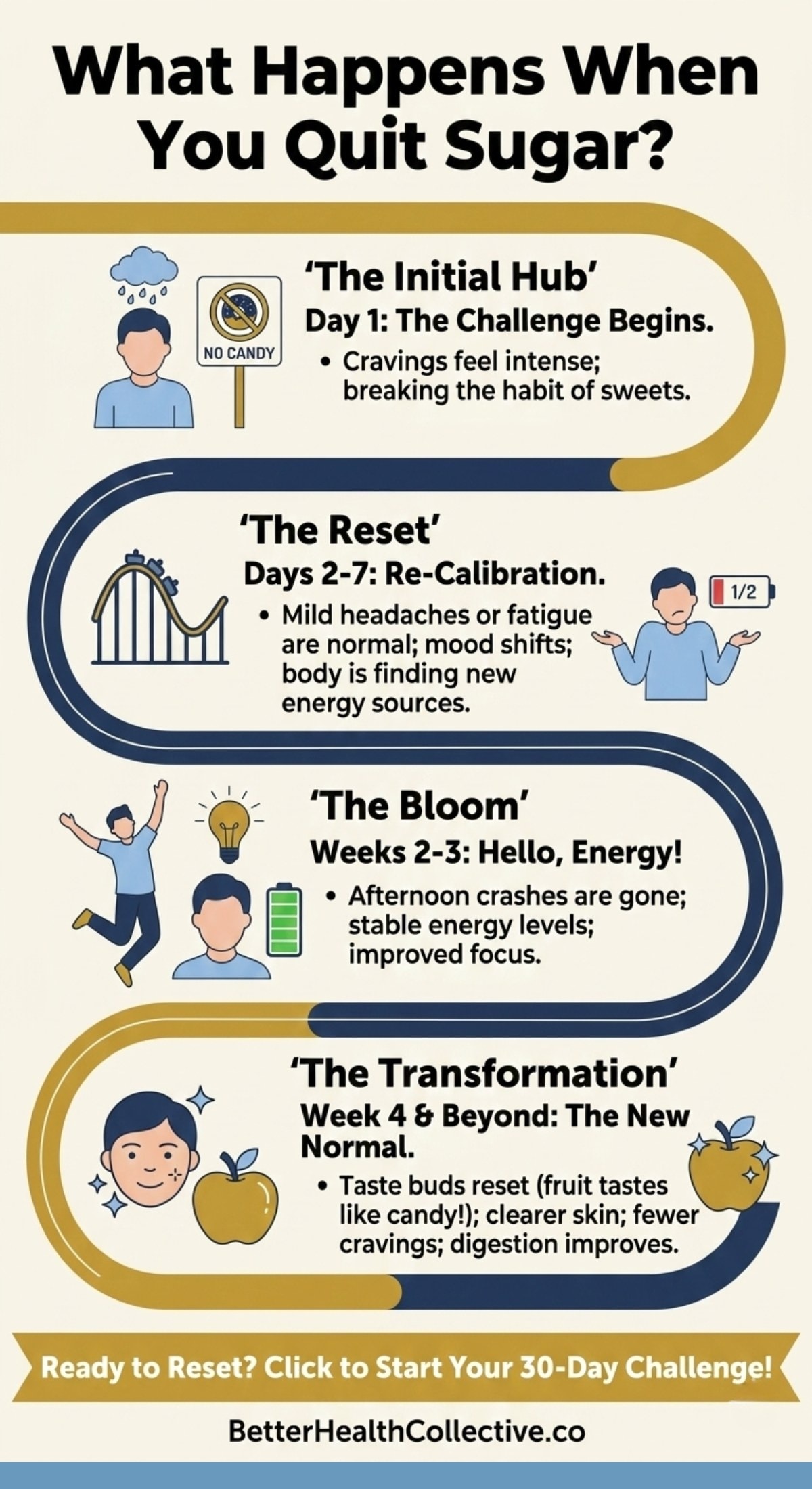
After about two weeks, things get weird—in a good way.
- Stable Energy: You stop feeling like you need a nap at 2:00 PM.
- Clearer Skin: “Sugar breakouts” are a real thing, and they start to vanish.
- Decreased Cravings: Often it’s a dramatic decrease. That means fewer sugar cravings during the day and spending nights staring into your refrigerator is just something you “used to do.”
- Improved Digestion: That simply means less bloating and gas, and more regular bowel movements
- The Taste Reset: This is the coolest part. An apple starts tasting like candy. A strawberry tastes incredibly sweet. You’ve officially “re-calibrated” your palate.
A Quick Note on “Slipping Up”
If you eat a piece of cake at a birthday party, it’s fine. You didn’t “ruin” anything.
The “all-or-nothing” mindset is what kills progress. Just make your next meal a healthy one and keep moving.
Self-compassion is a way better motivator than guilt.
Want to hear from someone else who quit sugar?
This is such a GOOD video and definitely worth 10 minutes of your life! She offers so many fantastic tips and ideas for removing or reducing sugar from your daily diet.
Frequently Asked Questions (FAQs)
How much sugar is too much each day?
Health organizations generally recommend limiting added sugar to about 25 grams (6 teaspoons) per day for women and 36 grams (9 teaspoons) per day for men.
The challenge is that added sugar can show up in many packaged foods throughout the day — from yogurt and granola bars to salad dressings and sauces — so it can add up quickly. Simply becoming more aware of hidden sugars and choosing whole foods more often can dramatically reduce how much added sugar you consume.
What should I watch out for when reading food labels?
When reading food labels, look for “Added Sugars” under the carbohydrate section. This number tells you how much sugar was added during processing, which is the type most health experts recommend limiting.
When you look at the ingredients, watch out for hidden sugars like dextrose, high-fructose corn syrup, maltodextrin, sucrose, fructose, glucose, and lactose. You can read more about this in a recent article from the CDC.
Wait, is fruit okay?
Yes! Please eat fruit. It has fiber and vitamins that keep your blood sugar from spiking like a candy bar would. It’s nature’s way of giving you a sugar fix without the crash.
How long until the cravings stop?
Usually, the first 3–5 days are the hardest. By day 10, you’ll feel like a different person. By day 30, you’ll wonder why you were so obsessed with those vending machine snacks in the first place.
Do I have to quit sugar forever? Definitely not! The goal is to make sugar a choice, not a compulsion. You want to be the person who can enjoy a slice of pie on Thanksgiving and then not think about sugar again for a week.
If I do eat sugar, when is the best time to have it?
Many people find that having sugar with or after a balanced meal works better than eating it by itself. When sweets are paired with foods that contain protein, fiber, or healthy fats, the body tends to absorb sugar more slowly, which can help reduce the sharp energy spikes and crashes that often lead to cravings later.
For example, enjoying dessert after dinner rather than as a standalone snack can sometimes make it easier to avoid the cycle of sugar cravings throughout the day.
Final Thoughts
Breaking the sugar cycle doesn’t have to mean extreme dieting or perfect discipline.
For most of us, it’s really just about building better awareness—starting with the big hitters, finding satisfying replacements for snacks, and noticing where those hidden sugars like to hang out.
The goal of this 30-day challenge isn’t to banish every gram of sugar for the rest of your life. It’s simply to help you get back in the driver’s seat. Once you break the cycle and regain control over cravings, sweets can become what they were meant to be: an occasional treat you actually enjoy, rather than a daily habit your body demands.
You might be surprised by how quickly your body adjusts. Give it a little time, and you’ll likely find that you naturally want less sugar than you ever expected.
Related Articles:
- Blood Sugar Crashes: The Real Reason You Get Afternoon Food Cravings
- The Blood Sugar Rollercoaster: Why Your Body is Demanding Dessert
- Late Night Cravings: Why They Happen & What To Do Instead
- High Fiber Breakfast Ideas to Reduce Sugar Cravings & Keep You Full
Please note: This website contains affiliate links. As an Amazon Associate, we earn from qualifying purchases at no additional cost to you.